

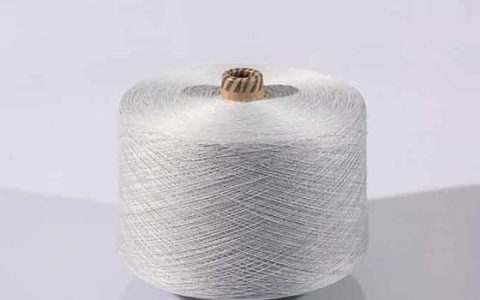




What Is Stainless Steel Yarn?
2026-09-04 13:42
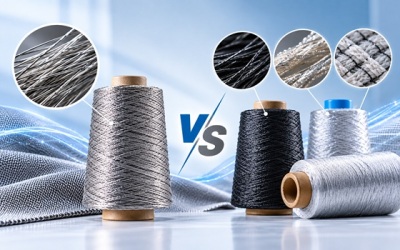
Stainless steel yarn is a functional textile material that combines the flexibility and processability of conventional yarns with the electrical, thermal, and durability characteristics of stainless steel. Depending on its construction, it may consist entirely of fine stainless steel filaments or combine stainless steel fiber with textile fibers such as polyester, wool, cotton, or flame-resistant fibers.
Unlike ordinary textile yarn, which is primarily designed to provide strength, appearance, comfort, or insulation, stainless steel yarn can introduce electrical conductivity and electrostatic dissipation into a textile structure. This makes it an important material for antistatic fabrics, protective clothing, smart textiles, conductive fabrics, industrial textiles, sensors, and other technical applications.
As industries increasingly demand textiles that do more than provide basic mechanical performance, conductive materials are becoming more important. From ESD protection and smart wearables to industrial monitoring and functional workwear, stainless steel-based yarns provide textile manufacturers with a practical way to integrate conductivity directly into woven, knitted, sewn, or embroidered structures.
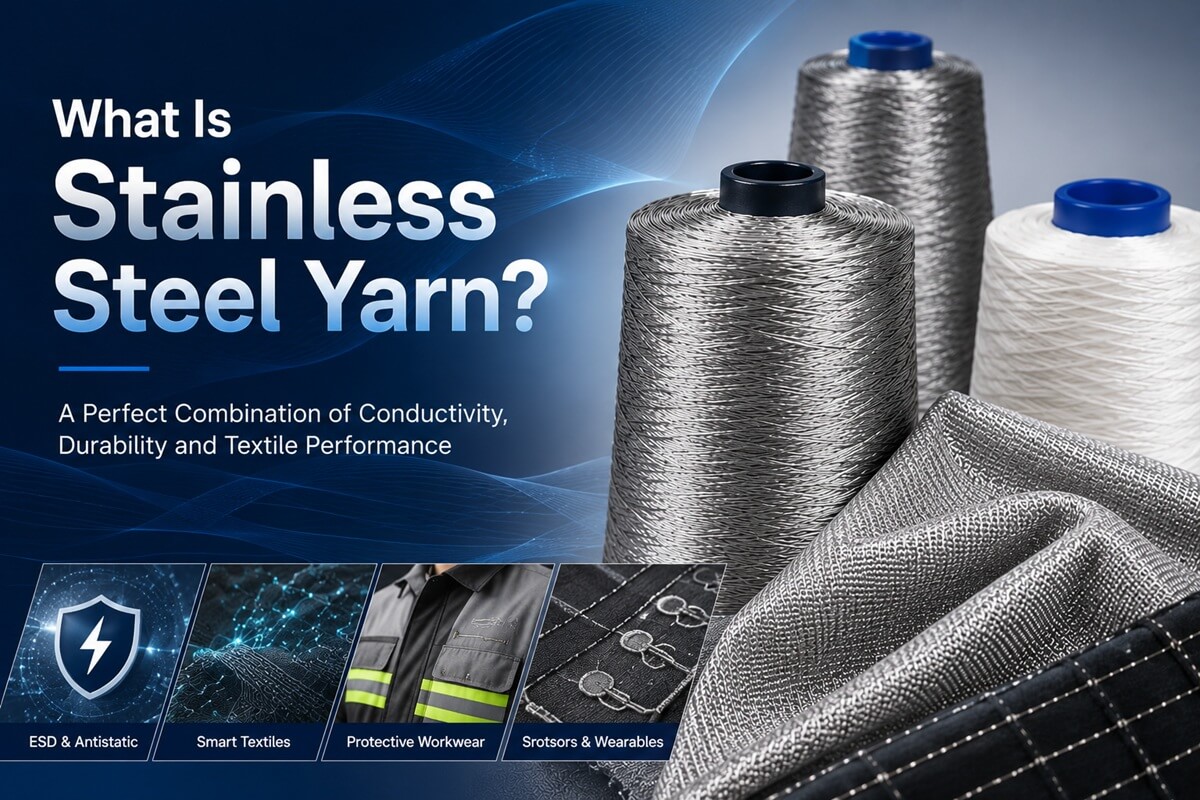
What Is Stainless Steel Yarn Made Of?
The term stainless steel yarn does not refer to one single construction.
At the material level, stainless steel can be processed into extremely fine fibers or filaments. These metallic elements can then be used alone or combined with conventional textile fibers to create yarns with different levels of conductivity, flexibility, strength, comfort, and processability.
Commercial stainless steel textile materials can generally be divided into three categories:
| Type | Typical Construction | Main Characteristics | Typical Applications |
|---|---|---|---|
| 100% stainless steel filament yarn | Fine continuous stainless steel filaments | High conductivity, corrosion resistance, durability | Smart textiles, signal transmission, sensors |
| Stainless steel blended yarn | Stainless steel fiber blended with polyester, wool, cotton, FR fibers, etc. | Balances conductivity with textile properties | Antistatic fabrics, workwear, industrial textiles |
| Wrapped/composite yarn | Stainless steel component combined or wrapped with textile fibers | Improved textile processing and flexibility | Embroidery, sensors, wearable textiles |
For example, commercially available stainless steel spun yarn can contain 20% stainless steel fiber and 80% polyester or cotton, although the actual composition varies according to the required electrical and textile properties.
The appropriate construction therefore depends on what the final fabric needs to achieve. A yarn designed primarily for electrostatic dissipation does not necessarily need the same conductivity as one used for signal transmission or an electronic textile sensor.
How Does Stainless Steel Yarn Work?
The key functional component is the metal itself.
Metals contain mobile electrons, which allow electrical charge to move through the material much more readily than through common textile fibers such as polyester. When stainless steel elements are incorporated into a textile, they can create conductive pathways through which electrical charge can travel.
This is why stainless steel yarn is frequently classified as a type of conductive yarn.
However, "conductive" does not mean every stainless steel yarn has the same electrical resistance.
The final electrical performance can be influenced by factors including:
stainless steel content;
fiber or filament diameter;
yarn construction;
number of conductive filaments;
blending ratio;
contact between conductive elements;
textile construction;
environmental conditions;
required end use.
This is an important distinction for B2B buyers. Selecting a conductive textile material should not be based only on whether a supplier labels it "conductive." Electrical resistance, fabric construction, durability, processing method, and applicable standards should all be evaluated according to the intended application.
Stainless Steel Fiber vs. Stainless Steel Yarn
Although the two terms are closely related, stainless steel fiber and stainless steel yarn are not exactly the same thing.
Stainless steel fiber refers to the individual fine metallic fiber used as a functional raw material. These fibers may be incorporated into spun yarns, nonwovens, composites, and other technical materials.
Stainless steel yarn refers to a yarn structure suitable for textile processing. It may contain stainless steel fibers, continuous stainless steel filaments, or a combination of metal and conventional textile components.
A simplified relationship is:
Stainless Steel
→ Stainless Steel Fiber / Filament
→ Spinning, Blending, Wrapping or Combining
→ Stainless Steel Yarn
→ Weaving / Knitting / Sewing / Embroidery
→ Conductive or Functional Textile
This distinction is particularly useful when sourcing materials. Textile manufacturers typically need to specify not only the metallic raw material but also how it should be incorporated into the yarn and final fabric.
What Are the Main Properties of Stainless Steel Yarn?
1. Electrical Conductivity
One of the most important reasons for incorporating stainless steel into yarn is conductivity.
A conventional polyester or wool yarn is not intended to provide an electrical pathway. By adding stainless steel, the yarn can become electrically conductive or static dissipative.
This allows a conductive yarn to transfer electrical charge or help dissipate accumulated static electricity.
Depending on the construction, stainless steel conductive yarns can be used for applications ranging from basic ESD control to signal and energy transmission in electronic textiles.
2. Durable Antistatic Performance
Static electricity can become a serious concern in environments involving sensitive electronic equipment, combustible materials, flammable gases, dust, or other potentially hazardous conditions.
Instead of applying only a temporary surface treatment, conductive fibers can be physically integrated into the textile structure.
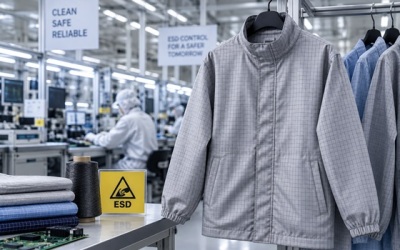
Stainless steel fibers are therefore used in antistatic protective clothing and other ESD-control textiles. The objective is to provide a conductive path that helps dissipate electrostatic charges rather than allowing them to accumulate.
For industrial users, durability after repeated laundering is particularly important. Conductive performance that works only on a new fabric may not be sufficient for reusable protective clothing.
3. Corrosion Resistance
Stainless steel is valued for its corrosion resistance compared with many ordinary metallic materials.
This characteristic is useful in technical textiles that may be exposed to humidity, repeated washing, perspiration, chemicals, or demanding operating environments.
Corrosion resistance is also one reason stainless steel is being explored for long-life smart textile applications where electrical functionality must remain stable over time.
4. Flexibility and Textile Processability
At first glance, steel and textiles may appear incompatible. Modern metal-fiber processing, however, can produce very fine stainless steel fibers and filaments.
These materials can be integrated into textile structures through processes such as:
weaving;
knitting;
sewing;
spinning;
embroidery.
This allows designers to introduce electrical functionality without turning the textile into a rigid metal structure.
5. Heat and Functional Performance
Stainless steel also offers useful thermal characteristics. Depending on the yarn and fabric design, metallic components may contribute to applications involving heat transfer, heating, thermal resistance, or protective functionality.
However, stainless steel content alone does not automatically make a garment flame resistant. For applications involving flame and heat hazards, the complete textile system—including the base fibers, fabric construction, finishing, garment design, and relevant certification—must be considered.
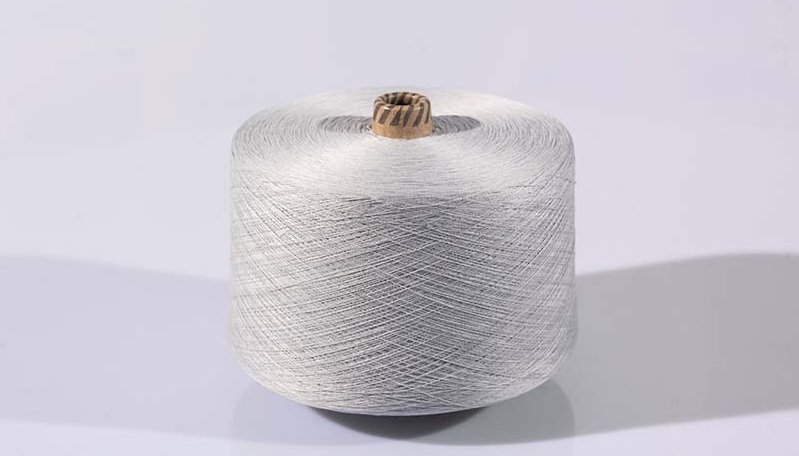
What Is Polyester Stainless Steel Yarn?
Polyester stainless steel yarn combines stainless steel conductive components with polyester.
This construction is particularly useful because the two materials contribute different properties.
Polyester offers familiar textile processing characteristics, mechanical performance, and cost efficiency, while stainless steel introduces conductivity and electrostatic dissipation.
The resulting yarn can therefore provide a balance between textile performance and electrical functionality.
For example, commercially available spun constructions may use stainless steel fibers blended with polyester, while other technical constructions use polyester around or alongside stainless steel conductive elements.
Potential applications include:
antistatic workwear;
conductive fabric;
ESD textiles;
industrial fabrics;
smart textiles;
sensors;
pressure-sensing textile structures.
A real-world example of this development can be found in pressure-sensing textiles. Polyester-wrapped stainless steel yarn has been used in embroidered pressure-sensing structures because it combines electrical conductivity with the flexibility needed to follow curved textile patterns.
This reflects an important trend in conductive textiles: the best solution is not necessarily the yarn with the maximum possible conductivity. Instead, manufacturers increasingly need materials that balance conductivity with flexibility, washability, textile compatibility, and long-term durability.
What Is FR Stainless Steel Yarn?
FR stainless steel yarn combines conductive stainless steel components with flame-resistant or flame-retardant textile materials.
This combination is particularly relevant to protective clothing.
In some working environments, users may face more than one hazard. A worker could require protection against flame or thermal exposure while also needing control of electrostatic discharge.
In such cases, a textile system can be engineered to provide multiple functional properties rather than treating flame resistance and antistatic performance as completely separate requirements.
For example, stainless steel conductive fibers may be combined with flame-resistant fibers to develop fabrics intended for protective garments.
However, buyers should distinguish between the properties of an individual yarn and the compliance of the finished garment.
Using FR stainless steel yarn does not automatically mean a finished fabric or garment complies with a particular flame-resistant or antistatic standard. Performance should be verified at the appropriate yarn, fabric, or garment level according to the intended market and application.
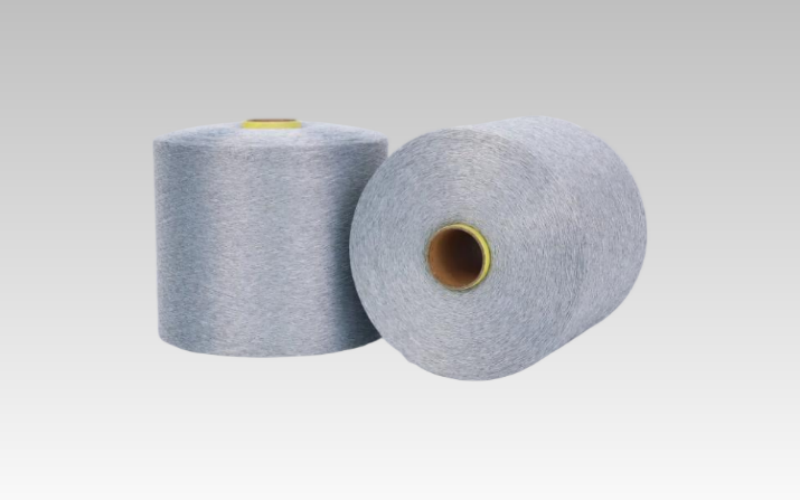
Stainless Steel Yarn vs. Conventional Conductive Materials
Conductive textiles can be produced using several approaches, including stainless steel fibers, silver-coated yarns, carbon-based materials, and conductive polymers.
Each technology has advantages and limitations.
| Material Approach | Conductivity | Durability | Corrosion Resistance | Textile Integration | Typical Focus |
|---|---|---|---|---|---|
| Stainless steel yarn | High, depending on construction | High | High | Good | ESD, industrial textiles, smart textiles |
| Silver-coated yarn | Very high | Depends on coating durability | Good | Very good | Wearables, sensors |
| Carbon-based yarn/fiber | Moderate to high depending on design | Good | High | Good | ESD, heating, technical textiles |
| Conductive polymer | Variable | Application-dependent | Generally good | Very good | Flexible electronics, smart textiles |
The comparison shows why stainless steel remains relevant even as new conductive materials emerge.
Silver can offer excellent electrical conductivity, but coating durability and cost may become important considerations. Carbon-based materials can provide useful conductivity with low weight, but their electrical and mechanical behavior differs from metal fibers.
Stainless steel offers an attractive combination of conductivity, mechanical durability, corrosion resistance, and compatibility with established textile manufacturing methods.
The correct material therefore depends on the target resistance, fabric construction, wash requirements, cost, comfort, and end-use environment.
How Is Stainless Steel Yarn Used in Textiles?
Stainless steel yarn can be incorporated into fabrics in different ways.
For antistatic workwear, conductive yarn may be introduced at controlled intervals to create a conductive grid within the base fabric. In other products, stainless steel fibers may be blended more uniformly throughout the yarn or fabric.
For smart textiles, conductive yarn can be sewn, woven, knitted, or embroidered into specific pathways that carry electrical signals or energy.
Current applications of stainless steel conductive textile materials include:
antistatic protective garments;
ESD-control textiles;
conductive workwear;
smart clothing;
wearable sensors;
RFID-related textile structures;
pressure sensors;
industrial filter materials;
conductive flooring and carpets;
EMI shielding textiles.
This diversity illustrates why stainless steel yarn should be viewed as a platform material rather than a single-purpose yarn.
Why Stainless Steel Yarn Matters for Modern Functional Textiles
The textile industry is moving toward multifunctional materials.
A fabric may now be expected to provide comfort while also controlling static electricity. Protective clothing may need flame resistance together with ESD performance. Smart garments may need to transmit data without becoming stiff or uncomfortable.
Stainless steel yarn fits this transition because it bridges two traditionally separate material categories: metals and textiles.
The stainless steel component provides electrical and functional properties, while textile fibers and yarn engineering make the material suitable for conventional textile manufacturing.
This is also why terms such as polyester stainless steel yarn, FR stainless steel yarn, and wool stainless steel yarn are important. They represent different engineering approaches to the same fundamental challenge: integrating metallic functionality into a textile without sacrificing the properties required by the final application.
Conclusion
Stainless steel yarn is a functional textile yarn containing fine stainless steel fibers or filaments, either alone or in combination with conventional textile materials. Its most important characteristics include electrical conductivity, electrostatic dissipation, corrosion resistance, durability, and compatibility with textile processing.
As antistatic textiles, smart clothing, wearable sensors, multifunctional workwear, and other technical textiles continue to develop, the role of conductive yarn is expanding beyond basic static dissipation.
Selecting the right stainless steel yarn requires balancing electrical performance with fiber composition, fabric design, durability, comfort, manufacturing method, and end-use requirements. When these factors are considered together, stainless steel yarn can serve as a versatile building block for the next generation of functional and intelligent textiles.
Related News
Read More >-
![How to Choose Stainless Steel Yarn for Conductive Textiles?]()
How to Choose Stainless Steel Yarn for Conductive Textiles?
Learn how to choose stainless steel yarn for conductive textiles. Compare fiber content, electrical resistance, yarn count, durability, and testing requirements.
-
![Stainless Steel Yarn vs. Conductive Yarn: What's the Difference?]()
Stainless Steel Yarn vs. Conductive Yarn: What's the Difference?
Compare stainless steel yarn with carbon and silver-coated conductive yarns. Explore differences in conductivity, durability, flexibility, and applications.
-
![How Does an Antistatic Jacket Work?]()
How Does an Antistatic Jacket Work?
Learn how an antistatic jacket works, how conductive yarn and antistatic fabric dissipate static charge, and what affects ESD protection performance.
-
![What Is an Antistatic Jacket?]()
What Is an Antistatic Jacket?
Learn what an antistatic jacket is, how it works, the materials used, key applications, ESD standards, and how to choose the right jacket for work.
-
![What Is Stainless Steel Yarn Used For?]()
What Is Stainless Steel Yarn Used For?
Discover what stainless steel yarn is used for, from antistatic and EMI shielding fabrics to smart textiles, heating, and protective clothing.
-
![What Are Flame Retardant Textiles?]()
What Are Flame Retardant Textiles?
Learn what flame retardant textiles are, how they work, key fabric types, applications, standards, and how to choose flame-resistant fabrics for protective clothing.
-
![What is Cotton Flame Retardant Fabric?]()
What is Cotton Flame Retardant Fabric?
Explains what cotton flame retardant fabric is, how it works, how it differs from inherent FR materials, where it is used, what standards buyers should consider, and how to select the right fabric for a protective clothing program.
-
![Which is Better, Aramid or Kevlar Fabric?]()
Which is Better, Aramid or Kevlar Fabric?
Compare aramid fabric vs Kevlar fabric, including strength, flame resistance, applications, and key differences to choose the right protective material.