



How Does an Antistatic Jacket Work?
2026-09-24 10:30
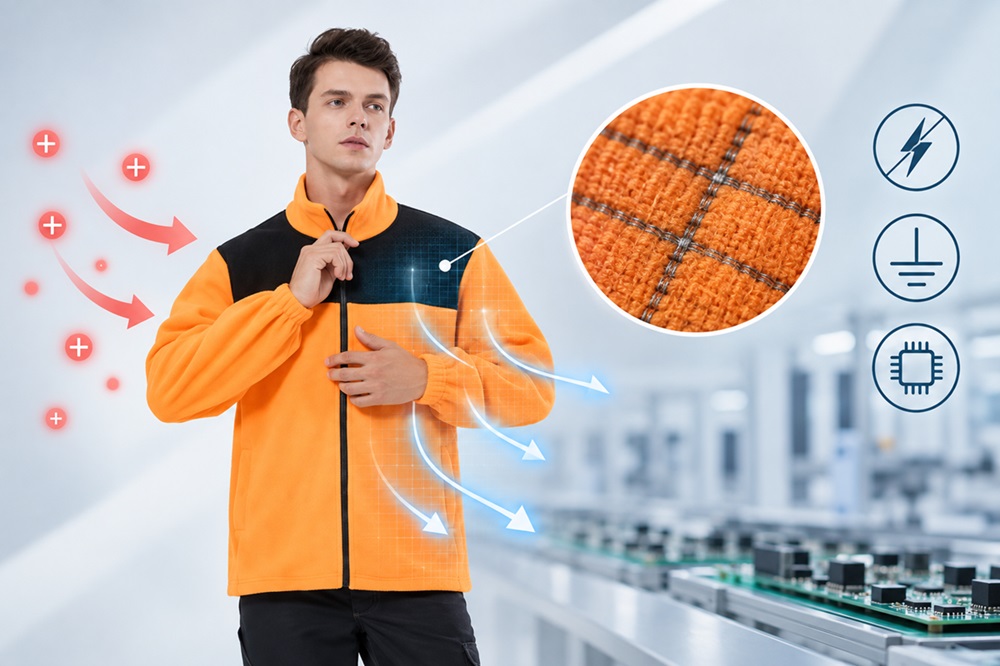
An antistatic jacket works by controlling the buildup and movement of electrostatic charge on clothing. Instead of allowing static electricity to accumulate on ordinary insulating fibers, the jacket uses antistatic fabric containing conductive fibers or yarns. These conductive elements form pathways through the fabric that help distribute and dissipate electrical charge in a controlled way.
This is particularly important in electronics manufacturing, cleanrooms, petrochemical operations, precision manufacturing, and other environments where electrostatic discharge (ESD) can affect sensitive components or workplace processes.
The key point is that an antistatic jacket does not work simply because it looks like protective workwear. Its performance comes from the interaction between conductive yarn, fabric structure, garment design, and the overall ESD control system.
Why Does Static Electricity Build Up on Clothing?
To understand how an antistatic jacket works, it helps to first understand how clothing becomes electrically charged.
Static electricity can develop when two materials come into contact and then separate. Everyday movements—walking, sitting, removing clothing, or rubbing one textile surface against another—can contribute to charge generation.
Many conventional textile fibers, particularly synthetic materials, are relatively poor electrical conductors. Once a charge develops, it may remain localized instead of dissipating quickly.
The result is electrostatic charge buildup.
If the electrical potential becomes sufficient and a discharge path becomes available, the accumulated charge can be released suddenly as an electrostatic discharge.
In everyday life, this may be little more than an unpleasant shock. In an ESD-sensitive production environment, however, electrostatic discharge can interfere with sensitive electronic components or controlled industrial processes.
This is why ordinary workwear and ESD protective clothing are not functionally equivalent.
How Does Antistatic Fabric Control Static Electricity?
The main functional component of an antistatic jacket is its fabric.
An antistatic fabric typically combines conventional textile fibers with electrically conductive elements. Instead of relying entirely on insulating fibers, the textile incorporates conductive fibers or yarns at controlled intervals.
A common structure might contain:
Polyester or polyester-cotton base yarns
Conductive carbon fibers or conductive yarn
A grid or stripe conductive pattern
A woven or knitted structure designed for the intended garment
For example, antistatic workwear fabrics can combine polyester and cotton with conductive carbon fiber arranged in a regular grid. The base fibers provide the textile properties required for clothing, while the conductive component provides a pathway for electrostatic charge.
Conductive Yarn Creates a Charge-Dissipation Network
The conductive yarn is one of the most important parts of this system.
Instead of allowing electrical charge to remain concentrated in one area, conductive elements help distribute it across the textile structure. When these yarns are incorporated repeatedly throughout the fabric, they create a conductive network.
The principle can be summarized as:
| Stage | What Happens |
|---|---|
| 1. Charge generation | Movement and contact between materials generate electrostatic charge |
| 2. Charge collection | Charge reaches the garment surface or textile structure |
| 3. Charge distribution | Conductive fibers help spread localized charge |
| 4. Charge dissipation | The charge is dissipated through the conductive system |
| 5. ESD control | Sudden uncontrolled discharge becomes less likely |
This is why the position and distribution of conductive yarn matter. Simply adding a small conductive component somewhere in a garment does not automatically produce reliable ESD performance.
Why Do Antistatic Fabrics Often Have Grid or Stripe Patterns?
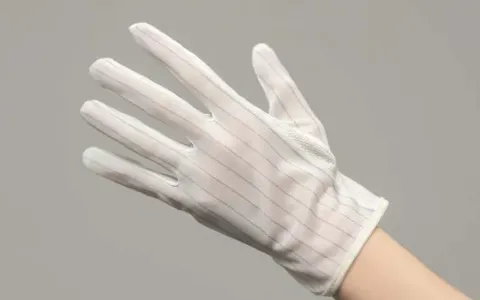
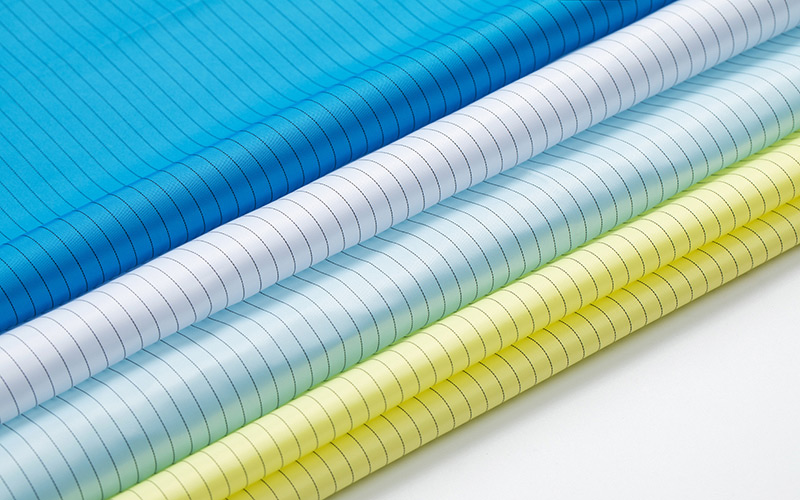
If you look closely at many ESD jackets, you may notice fine dark lines forming a grid or stripe pattern.
These lines are often associated with the conductive yarn incorporated into the fabric.
Grid and stripe constructions allow conductive elements to be distributed systematically throughout the textile. The appropriate arrangement depends on the fabric design, conductive material, resistance requirements, and intended application.
For example, a grid structure creates intersecting conductive paths in two directions, while a stripe construction places conductive yarns at regular intervals in one direction.
CJTI produces antistatic fabrics in different grid and stripe constructions using conductive carbon fibers with polyester or polyester-cotton base materials.
However, a smaller grid or a higher proportion of conductive material should not automatically be interpreted as "better." The required construction depends on the target electrostatic performance, comfort, durability, fabric weight, application, and relevant testing requirements.

Does an Antistatic Jacket Send Static Electricity to the Ground?
This question requires an important distinction.
An antistatic jacket helps control, distribute, and dissipate electrostatic charge, but it should not be viewed as an independent grounding device.
In an ESD Protected Area, clothing usually works as one component of a broader electrostatic control system. Depending on the workplace, this system may also include:
ESD flooring
ESD footwear
Grounding systems
Wrist straps
ESD work surfaces
Humidity control
Grounded equipment
The jacket helps prevent localized charge accumulation and controls charge associated with the wearer's clothing. The overall ESD system then manages how charges are controlled relative to ground and sensitive equipment.
This distinction is particularly important for B2B buyers. A supplier should not claim that an antistatic jacket alone eliminates every ESD risk.
How Does Garment Design Affect ESD Performance?
The fabric is essential, but an ESD jacket is more than a piece of antistatic fabric.
Garment construction determines how the textile surrounds the wearer and how consistently the conductive fabric performs during normal movement.
Important design considerations can include:
Garment Coverage
The jacket should provide appropriate coverage for the intended working environment. In electronics production, for example, an ESD garment may be used to help control charges associated with the wearer's underlying clothing.
Closures
Zippers, snaps, and other closure systems influence how the jacket fits and functions as a complete garment. The required design depends on the applicable ESD specification and workplace system.
Cuffs and Sleeves
Sleeves and cuffs affect coverage around the arms and wrists. Depending on the garment design, conductive cuffs or other specialized constructions may be used.
Seams and Accessories
Pockets, seams, labels, and accessories should be considered as part of the garment rather than added without regard to ESD requirements.
For this reason, buyers should evaluate both antistatic fabric performance and finished-garment design.
Conductive Yarn vs. Antistatic Treatment: What Is the Difference?
Not all products marketed as antistatic achieve their properties in the same way.
Some textiles may use surface treatments or chemical finishes to reduce static buildup. Other fabrics incorporate conductive fibers directly into the textile structure.
For industrial antistatic workwear, conductive yarn integrated into the fabric offers an important advantage: the conductive component is physically built into the textile rather than existing only as a surface finish.
CJTI's ESD fabrics, for example, use conductive carbon fibers integrated into polyester or polyester-cotton constructions. Its conductive textile portfolio also includes specialized conductive yarns for antistatic and cleanroom applications.
For B2B sourcing, buyers should therefore ask how the antistatic property is achieved, rather than relying only on an "antistatic" product description.
What Factors Determine How Well an Antistatic Jacket Works?
Several variables affect actual performance.
| Factor | Why It Matters |
|---|---|
| Conductive material | Determines how electrical charge can move through the textile |
| Conductive yarn distribution | Influences the continuity of the conductive network |
| Fabric construction | Affects electrical and physical performance |
| Garment design | Determines coverage and how the fabric functions when worn |
| Washing and maintenance | Can influence long-term garment condition and performance |
| ESD environment | Determines what level and type of protection are required |
| Testing standard | Provides measurable criteria for evaluating performance |
This explains why two jackets described as "antistatic" may perform differently.
For professional procurement, specifications should therefore go beyond fabric color, weight, and fiber composition.
How Can You Tell Whether an Antistatic Jacket Works?
Visual inspection alone is not enough.
A grid pattern may indicate the presence of conductive yarn, but it does not prove that the finished jacket meets a particular electrostatic requirement.
Depending on the application and market, antistatic protective clothing may be evaluated according to standards such as the EN 1149 series. ESD-controlled electronics environments may also operate under requirements associated with IEC 61340-5-1.
For example, CJTI lists EN 1149 and GB 12014-2019 for several of its antistatic fabrics intended for workwear.
When sourcing an ESD jacket, buyers should therefore confirm:
Which standard is required?
Is the test result for the yarn, fabric, or finished garment?
What conductive fiber or yarn is used?
What is the grid or stripe construction?
How should the garment be washed and maintained?
Does performance need to be verified after repeated laundering?
Is additional protection such as flame resistance also required?
These questions provide much more useful information than simply asking whether a jacket is "ESD safe."
How Does an Antistatic Jacket Fit Into a Complete ESD Clothing System?
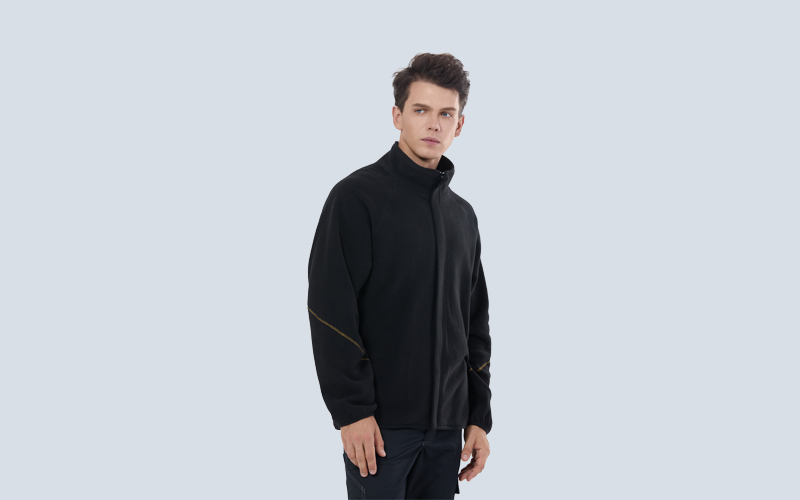
An effective antistatic jacket should be considered part of the complete workplace ESD strategy.
The functional chain begins with conductive yarn, continues through the design of the antistatic fabric, and ultimately reaches the finished jacket or other protective garment.
CJTI works across these stages, including conductive yarns, antistatic fabrics, and functional clothing for applications such as electronics, cleanrooms, petrochemicals, precision manufacturing, and other static-sensitive environments.
For B2B buyers developing customized antistatic workwear, this yarn-to-fabric-to-garment approach is useful because the required electrostatic performance can be considered together with fabric weight, fiber composition, garment style, comfort, durability, and additional protective requirements.
Frequently Asked Questions
Does an antistatic jacket completely eliminate static electricity?
No. Its purpose is to control electrostatic charge and reduce uncontrolled buildup and discharge. It normally functions as part of a broader ESD control system rather than eliminating every source of static electricity.
Why is conductive yarn used in an antistatic jacket?
Conductive yarn creates pathways that help distribute and dissipate electrical charge through the fabric. Without these conductive elements, conventional textile fibers may allow charge to remain localized.
Why do ESD jackets have a grid pattern?
Many ESD fabrics use conductive yarn arranged in grids or stripes. This distributes conductive elements throughout the textile and helps create a consistent charge-dissipation network.
Is an antistatic jacket the same as a cleanroom jacket?
Not necessarily. A cleanroom garment focuses on contamination control, while an antistatic jacket focuses on electrostatic control. Some garments are engineered to provide both functions for cleanroom environments where ESD protection is also required.
Does washing affect an antistatic jacket?
It can, depending on the conductive technology, garment construction, washing method, and number of laundering cycles. Industrial users should follow specified care procedures and confirm any required performance testing after laundering.
Conclusion
So, how does an antistatic jacket work? It works by integrating conductive fibers or yarns into the fabric to create pathways for controlling, distributing, and dissipating electrostatic charge. Grid or stripe constructions help extend this conductive network throughout the garment, while appropriate garment design helps the fabric function effectively when worn.
For industrial applications, however, the jacket should never be evaluated in isolation. Reliable ESD control depends on the combination of conductive materials, fabric construction, garment design, testing requirements, maintenance, and the wider workplace ESD system.
For B2B buyers, understanding this mechanism makes it easier to specify the right antistatic jacket—not simply by appearance or product name, but by the electrostatic performance required for the actual working environment.
Related News
Read More >-
![What Is an Antistatic Jacket?]()
What Is an Antistatic Jacket?
Learn what an antistatic jacket is, how it works, the materials used, key applications, ESD standards, and how to choose the right jacket for work.
-
![What Is Stainless Steel Yarn Used For?]()
What Is Stainless Steel Yarn Used For?
Discover what stainless steel yarn is used for, from antistatic and EMI shielding fabrics to smart textiles, heating, and protective clothing.
-
![What Is Stainless Steel Yarn?]()
What Is Stainless Steel Yarn?
What is stainless steel yarn? Learn about its conductivity, properties, types, applications, and uses in antistatic, ESD, and functional textiles.
-
![What Are Flame Retardant Textiles?]()
What Are Flame Retardant Textiles?
Learn what flame retardant textiles are, how they work, key fabric types, applications, standards, and how to choose flame-resistant fabrics for protective clothing.
-
![What is Cotton Flame Retardant Fabric?]()
What is Cotton Flame Retardant Fabric?
Explains what cotton flame retardant fabric is, how it works, how it differs from inherent FR materials, where it is used, what standards buyers should consider, and how to select the right fabric for a protective clothing program.
-
![Which is Better, Aramid or Kevlar Fabric?]()
Which is Better, Aramid or Kevlar Fabric?
Compare aramid fabric vs Kevlar fabric, including strength, flame resistance, applications, and key differences to choose the right protective material.
-
![What Is Aramid Fabric?]()
What Is Aramid Fabric?
Learn what aramid fabric is, its key properties, the differences between meta aramid fabric and para aramid fabric, common applications, and how to choose the right flame retardant fabric for industrial protective clothing.
-
![What is Level 5 Cut Resistant Clothing?]()
What is Level 5 Cut Resistant Clothing?