



How to Choose Stainless Steel Yarn for Conductive Textiles?
2026-10-15 15:01
Choosing the right stainless steel yarn for conductive textiles requires more than checking fiber composition or electrical conductivity. Textile manufacturers must also consider yarn count, stainless steel fiber content, mechanical strength, processing compatibility, and the performance requirements of the finished fabric.
A yarn that performs well in laboratory resistance testing may behave differently after weaving, knitting, washing, or repeated bending. Likewise, a higher stainless steel content does not automatically produce a better textile.
For B2B buyers, the most reliable approach is to define the target fabric performance, compare technical yarn specifications, and validate the selected material through sampling and testing before bulk production.
This guide explains the key factors to evaluate when sourcing stainless steel conductive yarn for industrial and functional textiles.
1. Start with the Performance Requirements of Your Conductive Textile
Before comparing yarn specifications, identify what the finished textile must achieve.
Different conductive textiles require different electrical and mechanical characteristics. For example, antistatic fabrics need controlled charge dissipation, while electromagnetic shielding fabrics must attenuate electromagnetic energy within a specified frequency range.
These requirements influence yarn selection, but they cannot be determined from the yarn's conductivity alone.
| Conductive Textile | Primary Performance Requirement | Key Selection Considerations |
|---|---|---|
| Antistatic fabric | Electrostatic charge dissipation | Resistance, conductive distribution, fabric structure |
| EMI shielding fabric | Electromagnetic attenuation | Metal content, yarn arrangement, shielding frequency |
| Smart textile | Stable electrical functionality | Resistance, flexibility, connection stability |
| Heating textile | Controlled electrical heating | Resistance, power requirements, thermal stability |
| Industrial protective fabric | Combined functional performance | Fiber composition, durability, relevant standards |
For example, if you are developing an EMI shielding fabric, the required shielding effectiveness should be established before selecting the yarn.
Similarly, for antistatic workwear, buyers should identify the applicable electrostatic requirements and evaluate whether the finished fabric can meet them.
The starting point should always be the textile specification, not simply the availability of a particular yarn.
2. Evaluate Stainless Steel Fiber Content and Blend Composition
One of the most important considerations is the percentage of stainless steel fiber in the yarn.
The conductive fiber content influences the formation of electrical pathways, but it also affects yarn flexibility, mechanical behavior, processing, and cost.
How Much Stainless Steel Fiber Is Needed?
There is no universal stainless steel percentage suitable for every conductive textile.
Increasing metal fiber content can improve conductive network formation in some constructions. However, the relationship between fiber content and electrical performance is not necessarily linear.
A yarn with a higher metal percentage may also become less suitable for certain textile processing requirements.
Buyers should therefore request samples with different blend ratios when the optimal composition has not been established.
Choosing the Supporting Fiber
Stainless steel blended yarn combines metallic fibers with conventional textile fibers to balance electrical functionality and textile performance.
Common options include:
Stainless steel/polyester yarn: Suitable for developing conductive fabrics where durability, dimensional stability, and textile processability are important.
Stainless steel/cotton yarn: An option for applications requiring conductivity together with cotton's textile characteristics.
Stainless steel/aramid yarn: Relevant to technical textiles requiring additional thermal or protective properties.
The supporting fiber should be selected according to the operating environment and finished-product requirements.
For example, polyester-based blends should not automatically be selected for applications involving temperatures beyond the polyester component's limits.
3. Check Electrical Resistance, Not Just Conductivity Claims
Suppliers frequently describe their products as conductive, antistatic, or electrically functional. However, these descriptions are insufficient for technical material selection.
Buyers should request measurable electrical performance data.
Understanding Yarn Resistance
Electrical resistance indicates how strongly a material opposes electrical current.
For conductive yarn, resistance may be reported in ohms per unit length, such as Ω/m.
When comparing products, ensure that the measurement conditions are consistent. Relevant information includes:
Resistance value and measurement unit
Test method and specimen length
Applied measurement conditions
Yarn condition during testing
Variation between samples
Two yarns with similar fiber compositions may exhibit different resistance values because of differences in fiber distribution, yarn construction, and contact between conductive elements.
Consider Resistance Stability
Initial resistance is only part of the evaluation.
For textiles exposed to repeated movement, stretching, or washing, electrical resistance may change over time.
Manufacturers should therefore consider whether resistance remains sufficiently stable after the expected processing and use conditions.
This is especially important for conductive pathways, wearable electronics, and reusable industrial textiles.
4. Select the Right Yarn Count and Construction
Yarn count and construction directly affect how stainless steel yarn behaves during textile manufacturing.
A technically suitable conductive material may still cause production difficulties if its structure is incompatible with the intended equipment.
Yarn Count
Yarn count influences yarn thickness, fabric weight, appearance, and processing characteristics.
Depending on the spinning system, yarn specifications may be expressed using cotton count (Ne), tex, or other measurement systems.
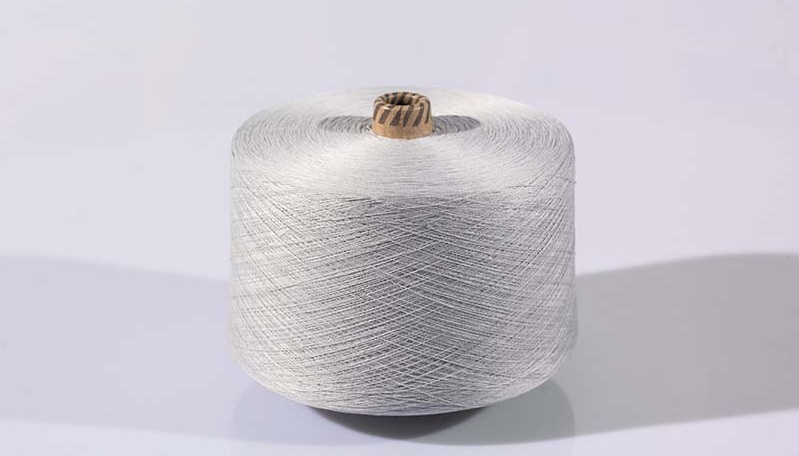
CJTI's 21s T70/Mf30 Stainless Steel Blend Yarn is an example of a ring-spun conductive blend. Its published product information lists a yarn count range of 10S–40S.
However, the correct count depends on the required fabric construction.
A finer yarn may support a lighter textile, while a coarser construction may be more appropriate for certain industrial fabrics. Neither is automatically superior in electrical performance.
Yarn Construction
The arrangement of stainless steel fibers within the yarn also matters.
Important considerations include fiber distribution, twist, yarn evenness, and the continuity of conductive elements.
Poor yarn uniformity can create processing problems and contribute to inconsistent electrical behavior.
For this reason, buyers should request yarn count tolerance, evenness information, and other relevant quality specifications rather than relying only on the nominal count.
5. Confirm Compatibility with Weaving or Knitting
One of the most common sourcing mistakes is selecting conductive yarn without considering the production process.
A yarn that meets laboratory electrical requirements may still be difficult to process on industrial textile machinery.
For Woven Conductive Fabrics
Manufacturers should evaluate yarn tensile strength, abrasion resistance, surface friction, and compatibility with the intended loom.
It is also important to determine whether the conductive yarn will be used in the warp, weft, or both directions.
This arrangement can significantly influence the conductive network of the finished fabric.
For Knitted Conductive Fabrics
Knitting introduces different mechanical requirements.
Yarns must withstand loop formation and repeated bending without excessive breakage or unacceptable changes in electrical performance.
The selected yarn should also provide sufficient flexibility for the required knitted structure.
Why Fabric Construction Matters
Research on metallic conductive textiles has shown that fabric structure and conductive yarn arrangement can strongly influence electromagnetic shielding effectiveness.
Therefore, increasing the amount of stainless steel yarn is not always the most effective way to improve performance.
Optimizing the fabric structure may sometimes deliver better results than simply increasing metal content.
6. Evaluate Durability and Environmental Resistance
Conductive textiles used in industrial environments may experience repeated laundering, abrasion, mechanical stress, or chemical exposure.
The selected yarn should be evaluated under conditions representative of its intended use.
Washing and Abrasion
For reusable textiles, electrical resistance should be assessed before and after relevant laundering or abrasion tests.
Although stainless steel fibers provide corrosion resistance and do not rely on a separate conductive surface coating, this does not guarantee that every blended yarn will retain identical electrical properties after repeated washing.
Mechanical Fatigue
Repeated bending and stretching may affect fine metallic fibers and their electrical connections.
This is particularly relevant to flexible conductive textiles that experience frequent movement.
Environmental Conditions
Temperature, humidity, chemicals, and the properties of supporting fibers may influence long-term performance.
Buyers should confirm that the complete yarn construction—not only the stainless steel component—is suitable for the operating environment.
7. Request Technical Specifications Before Placing an Order
For B2B sourcing, a complete technical specification is more valuable than a general product description.
The following checklist can help buyers compare stainless steel fiber yarn suppliers.
| Specification | Information to Request | Why It Matters |
|---|---|---|
| Fiber composition | Stainless steel percentage and supporting fibers | Determines material suitability |
| Yarn count | Nominal count and tolerance | Supports fabric design and processing |
| Electrical resistance | Value, unit, and test method | Enables technical comparison |
| Yarn construction | Spinning method, twist, evenness | Affects processing and consistency |
| Mechanical properties | Tensile strength and elongation | Helps evaluate production compatibility |
| Durability | Relevant washing, abrasion, or bending results | Supports long-term performance assessment |
| Quality documentation | Test reports and batch inspection information | Helps verify specification compliance |
When requesting a quotation, buyers should also provide the intended textile application, expected order quantity, and any specific performance standards.
A clear technical request allows suppliers to recommend appropriate yarn constructions rather than offering a product based only on its name.
8. Validate Stainless Steel Yarn Through Sampling and Testing
Before bulk purchasing, manufacturers should conduct a structured sample evaluation.
A practical validation process includes three stages.
Stage 1: Evaluate the Yarn Sample
Check the supplied yarn against the agreed technical specifications.
This may include fiber composition, yarn count, tensile properties, electrical resistance, and visual uniformity.
Any significant differences should be clarified before fabric production.
Stage 2: Produce a Trial Fabric
Use the selected yarn on the intended weaving or knitting equipment.
During the trial, record processing performance, yarn breakage, fabric defects, and any difficulties associated with conductive yarn placement.
The trial should use a fabric construction representative of the planned commercial product.
Stage 3: Test the Finished Textile
Evaluate the fabric against its actual end-use requirements.
For antistatic fabrics, this may involve relevant electrostatic resistance or charge-dissipation testing.
For EMI shielding textiles, testing should cover the required frequency range and shielding performance.
If the textile will be washed or repeatedly flexed, include appropriate durability testing.
Bulk production should begin only after the yarn and finished fabric meet the agreed acceptance criteria.
9. Consider Quality Consistency for Bulk Production
A successful laboratory sample does not automatically guarantee consistent commercial production.
For industrial buyers, batch-to-batch stability is essential.
Variations in stainless steel fiber content, yarn count, blending uniformity, or processing conditions may influence both textile manufacturing and electrical performance.
Before confirming a bulk order, buyers should discuss:
Agreed specification tolerances
Incoming material inspection
Batch identification and traceability
Electrical performance testing frequency
Sample approval procedures
Handling of nonconforming materials
These requirements are particularly important when the yarn will be incorporated into textiles subject to customer specifications or compliance testing.
A supplier's ability to maintain consistent production quality can be as important as the performance of the initial sample.
Frequently Asked Questions
What stainless steel content is best for conductive textiles?
There is no universal percentage. The appropriate stainless steel content depends on the required electrical performance, supporting fibers, yarn construction, and finished-fabric design. Sample testing is recommended before selecting a blend ratio.
How do I measure the conductivity of stainless steel yarn?
Conductivity is commonly evaluated through electrical resistance measurements using an appropriate test method. Buyers should request the resistance value, measurement unit, test conditions, and relevant supporting data.
Can stainless steel blended yarn be used for knitting?
Yes, suitable stainless steel blended yarns can be used in knitted textiles. However, flexibility, tensile strength, yarn construction, and machine compatibility should be verified through production trials.
Does higher stainless steel content improve EMI shielding?
It can improve shielding performance in some textile constructions, but metal content is not the only factor. Yarn arrangement, fabric density, structure, and operating frequency also influence shielding effectiveness.
What should I check before buying stainless steel yarn in bulk?
Confirm fiber composition, yarn count, electrical resistance, mechanical properties, processing compatibility, testing requirements, and batch consistency. Trial fabric production is strongly recommended before bulk purchasing.
Conclusion
Choosing the right stainless steel yarn for conductive textiles requires a systematic evaluation of electrical performance, fiber composition, yarn construction, manufacturing compatibility, and durability.
For B2B buyers, the most effective sourcing process begins with the finished textile requirements, followed by technical specification review, yarn sampling, trial fabric production, and performance testing.
Rather than selecting a yarn based solely on stainless steel content or conductivity claims, manufacturers should focus on whether the material can consistently deliver the required performance in the final textile product.
Related News
Read More >-
![Stainless Steel Yarn vs. Conductive Yarn: What's the Difference?]()
Stainless Steel Yarn vs. Conductive Yarn: What's the Difference?
Compare stainless steel yarn with carbon and silver-coated conductive yarns. Explore differences in conductivity, durability, flexibility, and applications.
-
![How Does an Antistatic Jacket Work?]()
How Does an Antistatic Jacket Work?
Learn how an antistatic jacket works, how conductive yarn and antistatic fabric dissipate static charge, and what affects ESD protection performance.
-
![What Is an Antistatic Jacket?]()
What Is an Antistatic Jacket?
Learn what an antistatic jacket is, how it works, the materials used, key applications, ESD standards, and how to choose the right jacket for work.
-
![What Is Stainless Steel Yarn Used For?]()
What Is Stainless Steel Yarn Used For?
Discover what stainless steel yarn is used for, from antistatic and EMI shielding fabrics to smart textiles, heating, and protective clothing.
-
![What Is Stainless Steel Yarn?]()
What Is Stainless Steel Yarn?
What is stainless steel yarn? Learn about its conductivity, properties, types, applications, and uses in antistatic, ESD, and functional textiles.
-
![What Are Flame Retardant Textiles?]()
What Are Flame Retardant Textiles?
Learn what flame retardant textiles are, how they work, key fabric types, applications, standards, and how to choose flame-resistant fabrics for protective clothing.
-
![What is Cotton Flame Retardant Fabric?]()
What is Cotton Flame Retardant Fabric?
Explains what cotton flame retardant fabric is, how it works, how it differs from inherent FR materials, where it is used, what standards buyers should consider, and how to select the right fabric for a protective clothing program.
-
![Which is Better, Aramid or Kevlar Fabric?]()
Which is Better, Aramid or Kevlar Fabric?
Compare aramid fabric vs Kevlar fabric, including strength, flame resistance, applications, and key differences to choose the right protective material.