




Cleanroom Clothing vs. Antistatic Clothing: What's the Difference?
2026-10-22 10:13
Cleanroom clothing and antistatic clothing are designed to control different risks. Cleanroom clothing primarily prevents particles and contaminants from entering controlled environments, while antistatic clothing helps reduce electrostatic charge buildup and control electrostatic discharge (ESD).
Although these garments often use similar materials and may look almost identical, their protective functions are not interchangeable. A garment designed for static control does not necessarily meet cleanroom contamination requirements, and a low-linting cleanroom garment may not provide adequate ESD protection.
In industries such as semiconductor manufacturing, electronics assembly, and precision production, both functions may be necessary. Understanding the differences in fabric construction, garment design, testing requirements, and performance helps B2B buyers choose the appropriate protective clothing for their operations.
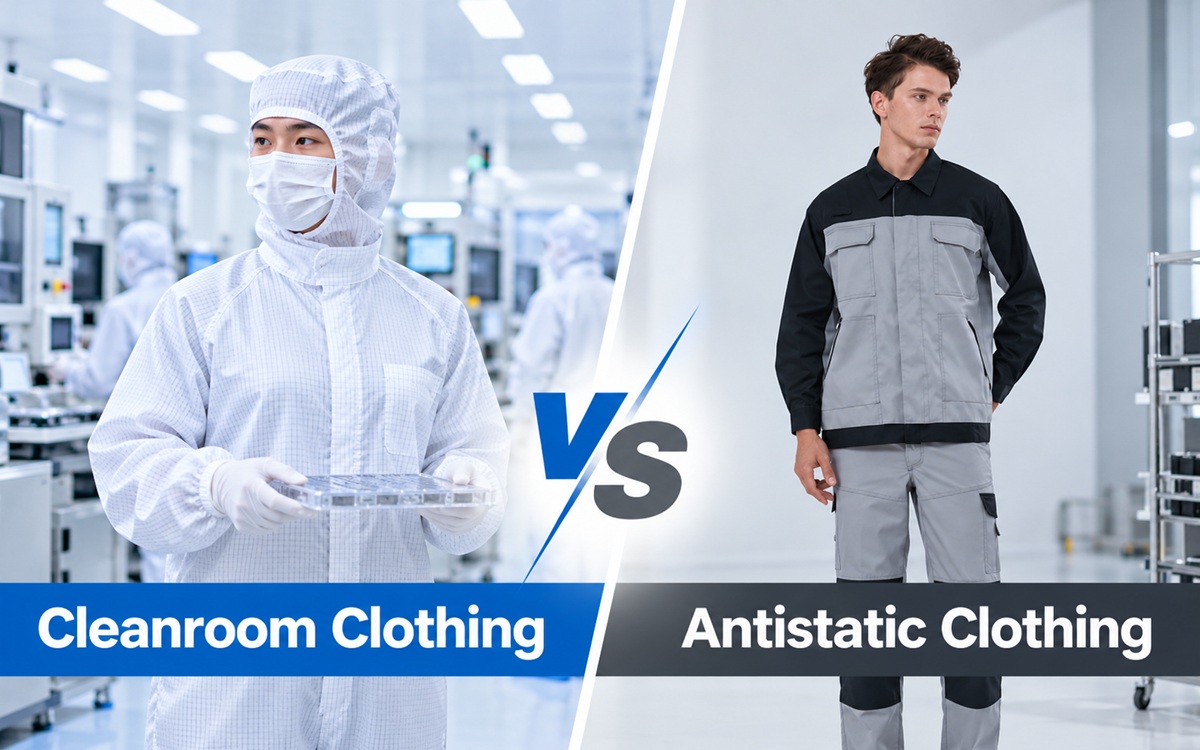
Cleanroom Clothing vs. Antistatic Clothing: Key Differences
The fundamental difference lies in what each garment is designed to control.
Cleanroom clothing minimizes contamination released by workers, including particles from skin, hair, and underlying garments. It serves as a barrier between personnel and the controlled environment.
Antistatic clothing, also known as ESD clothing in many industrial applications, is engineered to control electrostatic charge associated with clothing and reduce the risk of uncontrolled discharge.
The following table summarizes their main differences.
| Comparison | Cleanroom Clothing | Antistatic Clothing |
|---|---|---|
| Primary purpose | Contamination control | Electrostatic charge control |
| Main risk | Particle and microbial contamination | Static buildup and ESD |
| Typical fabrics | Low-linting, tightly constructed textiles | Fabrics incorporating conductive fibers |
| Key performance | Particle shedding and barrier effectiveness | Electrical resistance and charge dissipation |
| Common garments | Coveralls, hoods, cleanroom suits | ESD jackets, smocks, trousers, coveralls |
| Main industries | Pharmaceuticals, biotechnology, semiconductors | Electronics, precision manufacturing, industrial workwear |
| Relevant requirements | Cleanroom contamination-control procedures | ESD control and electrostatic protective clothing requirements |
These distinctions explain why garment selection should begin with workplace risks rather than product names.
1. Contamination Control vs. Electrostatic Discharge Protection
How Cleanroom Clothing Controls Contamination
Human operators are a potential source of contamination in controlled environments. Skin particles, hair, fibers, and microorganisms can be released during normal movement.
Cleanroom garments help limit the transfer of these contaminants into the surrounding environment.
Their effectiveness depends on fabric particle-shedding characteristics, barrier performance, garment coverage, closures, and correct gowning procedures.
For example, a pharmaceutical production area may require clothing that minimizes particle release and supports the facility's contamination-control strategy.
However, electrostatic conductivity alone does not establish whether a fabric provides adequate contamination control.
How Antistatic Clothing Controls ESD
Static electricity can accumulate when materials contact, separate, or rub against one another.
Conventional insulating textiles may retain electrical charge, creating a potential discharge risk in sensitive environments.
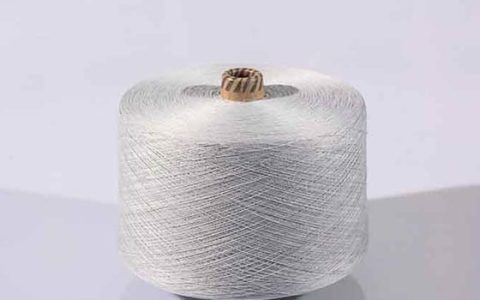
Antistatic workwear incorporates conductive materials that help distribute or dissipate charge. These conductive elements are often integrated into woven or knitted fabrics through carbon-containing filaments or other conductive yarn technologies.
For electronics manufacturing, this helps manage electrostatic risks associated with clothing.
However, an antistatic garment does not independently eliminate every ESD risk. It normally works alongside grounding systems, suitable footwear, ESD flooring, and other workplace controls.
2. Fabric Requirements: Low-Linting vs. Conductive Performance
Fabric construction is one of the most important differences between the two clothing categories.
Fabrics for Cleanroom Clothing
A suitable cleanroom fabricmust minimize the release and transfer of particles during use.
Common requirements include:
Low particle shedding
Suitable barrier properties
Resistance to repeated movement and abrasion
Compatibility with the required cleaning process
Appropriate comfort and breathability
Continuous-filament polyester fabrics are commonly used for reusable cleanroom garments because they can provide relatively low lint generation and consistent textile structures.
However, fabric composition alone does not establish cleanroom suitability. The finished material must be evaluated against the facility's contamination-control requirements.
Fabrics for Antistatic Clothing
An antistatic fabric requires an electrically functional component.
This is commonly achieved by integrating conductive yarn into a conventional textile base.
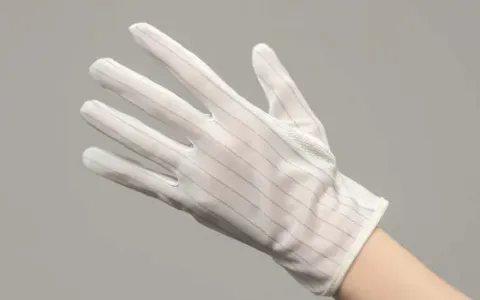
Carbon-containing conductive filaments may be arranged in grids or stripes to create conductive pathways throughout the fabric.
For example, CJTI supplies polyester-based and polyester-cotton antistatic fabrics containing conductive fibers for industrial workwear.
The electrical performance depends on the conductive material, yarn distribution, fabric construction, and applicable testing conditions.
Can One Fabric Provide Both Functions?
Yes. A fabric can be designed to combine low particle shedding with electrostatic control.
For example, tightly woven polyester filament fabrics incorporating conductive yarns may be suitable for certain ESD-sensitive cleanroom applications.
However, the two functions must be evaluated separately.
A fabric that meets an electrostatic requirement should not automatically be described as cleanroom-compatible without supporting contamination-control evidence.
Likewise, a low-linting fabric should not be assumed to provide effective ESD protection simply because it is polyester-based.
3. Garment Design: Coverage and Construction Requirements
The intended function also influences how the clothing is designed.
Cleanroom Garment Design
Cleanroom clothing focuses on minimizing contamination transfer from the wearer.
Depending on the environment, designs may include:
Full-body coveralls
Integrated or separate hoods
Closely fitted cuffs
Covered or concealed closures
Low-shedding seams and accessories
Compatible gloves and footwear
Higher-control environments may require comprehensive coverage, while other controlled areas may use simpler garment systems.
The appropriate design depends on the cleanliness requirements and operational procedures.

Antistatic Garment Design
For antistatic clothing, garment design must support electrostatic control.
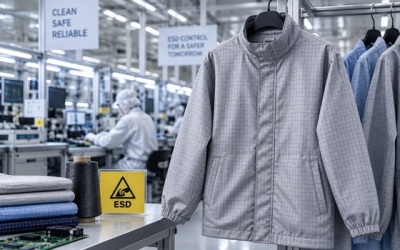
Common styles include ESD smocks, jackets, trousers, and coveralls.
Important considerations include garment coverage, fabric continuity, closures, cuffs, and compatibility with the wider ESD control system.
In some applications, an ESD smock is used to help control electrostatic charges associated with the wearer's underlying clothing.
Unlike a cleanroom coverall, however, a conventional ESD jacket may not provide sufficient particle containment for a controlled cleanroom environment.
4. What Standards Apply to Cleanroom and Antistatic Clothing?
Standards are particularly important because manufacturers sometimes use terms such as cleanroom safe, antistatic, and ESD protective without clearly identifying the associated test requirements.
| Standard or Framework | Main Focus | Relevance to Clothing |
|---|---|---|
| ISO 14644-1 | Classification of airborne particle cleanliness | Establishes cleanroom cleanliness classifications |
| ISO 14644-5:2025 | Cleanroom operations and contamination-control procedures | Includes personnel management and gowning programs |
| IEC 61340-5-1 | ESD control programs for electronic devices | Relevant to garments within electronics ESD control systems |
| ANSI/ESD S20.20 | ESD control programs | Used for managing electrostatic risks in electronics environments |
| EN 1149 series | Electrostatic properties of protective clothing | Relevant to specified electrostatic protective clothing applications |
An important distinction is that ISO 14644-1 classifies cleanroom air cleanliness, not the performance of an individual garment.
Similarly, IEC 61340-5-1 and ANSI/ESD S20.20 establish ESD control program requirements. Buyers should identify the applicable garment-specific measurements and acceptance criteria rather than treating these standards as simple product labels.
EN 1149 addresses electrostatic properties of protective clothing, particularly in relevant protective clothing applications. It should not automatically be treated as interchangeable with electronics ESD garment requirements.
For procurement, buyers should confirm exactly what has been tested: the raw fabric, finished garment, or complete clothing system.
5. When Do You Need Both Cleanroom and Antistatic Clothing?
Some manufacturing environments require both contamination control and electrostatic protection.
In these cases, selecting only one clothing category may leave important risks unaddressed.
Semiconductor Manufacturing
Semiconductor production is sensitive to airborne particles and electrostatic discharge.
Personnel clothing may need to limit particle release while also controlling electrostatic charge.
A suitable ESD cleanroom suit can incorporate low-linting fabric construction and conductive yarn technology.
Electronics Assembly in Controlled Environments
Electronics facilities operating ESD Protected Areas may use antistatic smocks or jackets.
If the production process also requires controlled airborne cleanliness, the garments must satisfy the additional contamination-control requirements.
An ordinary ESD jacket should not automatically be substituted for a qualified cleanroom garment.
Pharmaceutical and Biotechnology Production
In pharmaceutical cleanrooms, contamination control is generally a primary consideration.
Garment selection may involve particle containment, microbial contamination control, and compatibility with cleaning or sterilization procedures.
Antistatic performance may also be required where electrostatic risks are identified, but it is not a substitute for contamination-control performance.
Precision Optical Manufacturing
Optical components can be sensitive to particulate contamination, while certain electronic production processes may also involve ESD-sensitive equipment.
Depending on the process, clothing may therefore require one or both protective functions.
The key is to evaluate actual process risks rather than assuming that every cleanroom requires the same antistatic garment.
6. How to Choose Between Cleanroom Clothing and Antistatic Clothing
For B2B buyers, the most effective selection process begins with the operating environment.
Step 1: Identify the Primary Risk
Determine whether the workplace mainly requires contamination control, electrostatic control, or both.
For example, an electronics assembly area may prioritize ESD control, while a pharmaceutical production cleanroom may prioritize contamination containment.
Step 2: Define Performance Requirements
Specify the relevant cleanroom classification, contamination-control criteria, electrical performance requirements, and any additional workplace hazards.
Do not rely exclusively on broad descriptions such as "dust-free" or "ESD safe."
Step 3: Review Fabric Specifications
For cleanroom clothing, evaluate low-linting properties, barrier performance, durability, and cleaning compatibility.
For antistatic clothing, review conductive fiber composition, resistance measurements, and relevant electrostatic testing.
Where both functions are required, request evidence supporting each.
Step 4: Confirm Garment Construction
Check whether the garment provides appropriate coverage, closures, cuffs, seams, and compatible accessories.
The complete clothing system should match the working environment.
Step 5: Validate Samples and Documentation
Before bulk purchasing, request relevant test reports and evaluate garment samples under realistic use conditions.
For reusable clothing, consider whether the specified properties remain acceptable after the intended laundering cycles.
| Buyer Requirement | Recommended Priority |
|---|---|
| General contamination-controlled production | Low-linting cleanroom clothing |
| Electronics ESD Protected Area | Suitable ESD clothing within an ESD control program |
| ESD-sensitive semiconductor cleanroom | Combined cleanroom and ESD performance |
| Pharmaceutical cleanroom | Contamination-control requirements, with additional functions as needed |
| Industrial workwear with static hazards | Appropriate electrostatic protective clothing and other required protection |
This approach helps buyers avoid unnecessary specifications while ensuring that important performance requirements are not overlooked.
7. Cleanroom and Antistatic Clothing Solutions from CJTI
CJTI develops functional textiles and workwear for industrial and controlled environments, including cleanroom clothing, antistatic fabrics, conductive yarns, and finished ESD garments.
Its product range includes antistatic cleanroom garments manufactured using polyester and conductive fibers, as well as specialized clothing for electrostatic control.
For example, CJTI's Half Placket Antistatic Cleanroom Clothing combines polyester filaments with conductive yarns for controlled-environment applications.
CJTI also offers antistatic coveralls and garments with integrated hoods and foot coverings, allowing customers to consider different levels of coverage and functional requirements.
Buyers can explore antistatic clothing and cleanroom clothing solutions according to their industry and workplace needs.
For OEM and ODM projects, the sourcing discussion should begin with the required fabric performance, garment style, size range, application environment, and supporting test documentation.
This helps connect material selection with the performance requirements of the finished garment.

Frequently Asked Questions
Is cleanroom clothing always antistatic?
No. Some cleanroom garments incorporate conductive fibers for ESD control, but antistatic performance is not automatically guaranteed by the cleanroom clothing designation. Buyers should verify the applicable electrical specifications.
Can antistatic clothing be worn in a cleanroom?
Yes, provided it also meets the cleanroom's contamination-control requirements. Ordinary antistatic workwear may not have sufficiently low particle shedding or the appropriate garment construction for cleanroom use.
What is the difference between an ESD smock and a cleanroom coverall?
An ESD smock primarily supports electrostatic charge control, often covering the wearer's upper body and underlying clothing. A cleanroom coverall provides more extensive body coverage to help contain particles. Some garments are designed to perform both functions.
Does ISO 14644 certify antistatic clothing?
No. ISO 14644 addresses cleanrooms and associated controlled environments. Electrostatic garment performance requires evaluation against appropriate ESD or electrostatic protective clothing requirements.
What fabric is suitable for an ESD cleanroom suit?
Low-linting polyester filament fabrics incorporating conductive yarns are commonly used options. The final choice depends on contamination-control requirements, electrostatic performance, garment construction, and testing.
Conclusion
The main difference between cleanroom clothing and antistatic clothing is their protective purpose: cleanroom garments focus on contamination control, while antistatic garments manage electrostatic charge.
Although the two categories overlap, neither function should be assumed from appearance, fabric composition, or a general product label.
For environments requiring both cleanliness and ESD protection, buyers should select garments with verified low-particle and electrostatic performance.
By defining the risks, checking applicable requirements, and evaluating the complete garment system, manufacturers can choose protective clothing that supports reliable production and appropriate workplace control.
Related News
Read More >-
![How to Choose Stainless Steel Yarn for Conductive Textiles?]()
How to Choose Stainless Steel Yarn for Conductive Textiles?
Learn how to choose stainless steel yarn for conductive textiles. Compare fiber content, electrical resistance, yarn count, durability, and testing requirements.
-
![Stainless Steel Yarn vs. Conductive Yarn: What's the Difference?]()
Stainless Steel Yarn vs. Conductive Yarn: What's the Difference?
Compare stainless steel yarn with carbon and silver-coated conductive yarns. Explore differences in conductivity, durability, flexibility, and applications.
-
![How Does an Antistatic Jacket Work?]()
How Does an Antistatic Jacket Work?
Learn how an antistatic jacket works, how conductive yarn and antistatic fabric dissipate static charge, and what affects ESD protection performance.
-
![What Is an Antistatic Jacket?]()
What Is an Antistatic Jacket?
Learn what an antistatic jacket is, how it works, the materials used, key applications, ESD standards, and how to choose the right jacket for work.
-
![What Is Stainless Steel Yarn Used For?]()
What Is Stainless Steel Yarn Used For?
Discover what stainless steel yarn is used for, from antistatic and EMI shielding fabrics to smart textiles, heating, and protective clothing.
-
![What Is Stainless Steel Yarn?]()
What Is Stainless Steel Yarn?
What is stainless steel yarn? Learn about its conductivity, properties, types, applications, and uses in antistatic, ESD, and functional textiles.
-
![What Are Flame Retardant Textiles?]()
What Are Flame Retardant Textiles?
Learn what flame retardant textiles are, how they work, key fabric types, applications, standards, and how to choose flame-resistant fabrics for protective clothing.
-
![What is Cotton Flame Retardant Fabric?]()
What is Cotton Flame Retardant Fabric?
Explains what cotton flame retardant fabric is, how it works, how it differs from inherent FR materials, where it is used, what standards buyers should consider, and how to select the right fabric for a protective clothing program.